
Climate change, declining soil fertility and water scarcity are pushing farmers to find new ways to grow food. Hydroponic farming is one of the most practical. It does not replace traditional farming; it offers a way to grow where soil is poor, water is scarce or space is limited.
What is hydroponic farming?
Hydroponic farming grows plants without soil, in water that carries all the nutrients they need. The roots either sit in the solution or are fed by a steady flow of it, while oxygen, temperature and light are kept within a healthy range.
It is used in homes, schools, commercial farms and desert regions, which makes it relevant to water-scarce places such as Palestine.
Types of hydroponic systems
NFT (Nutrient Film Technique): a thin film of nutrient solution flows through channels holding the plants, then returns to the tank to be reused.
DWC (Deep Water Culture): roots hang in a tank of nutrient solution kept oxygenated by an air pump.
Wick system: a simple, low-cost option for home use, where wicks draw water from a reservoir up to the roots without a pump.
Ebb and flow: the growing tray is flooded with solution at intervals, then drained back to the tank.
Aeroponics, a related technique in which roots are misted in the air rather than held in water, is compared in our guide Aeroponics vs Hydroponics.
Benefits of hydroponic farming
1. Water conservation
Recirculating systems can use far less water than soil farming, because the same water is reused.
2. Higher yields
Nutrients reach the roots directly, so plants often grow faster and yield more in the same space.
3. Grow almost anywhere
Balconies, rooftops, classrooms and small indoor corners can all become growing spaces.
4. Less soil damage and fewer pesticides
Growing without soil avoids soil-borne pests, so fewer pesticides are usually needed.
5. Clean produce
Controlled conditions mean vegetables grow without contact with contaminated soil.
Limits to keep in mind
- Most systems rely on pumps, so a long power cut can damage the crop quickly.
- The nutrient solution needs regular checks of pH and strength.
- Set-up costs are higher than for a simple soil garden.
Hydroponics and smart farming
In larger hydroponic systems, temperature, light, humidity and nutrient levels can be monitored with sensors and adjusted, sometimes from a phone. Combined with renewable energy, this is part of what is often called smart agriculture.
What we learned from HydroVera
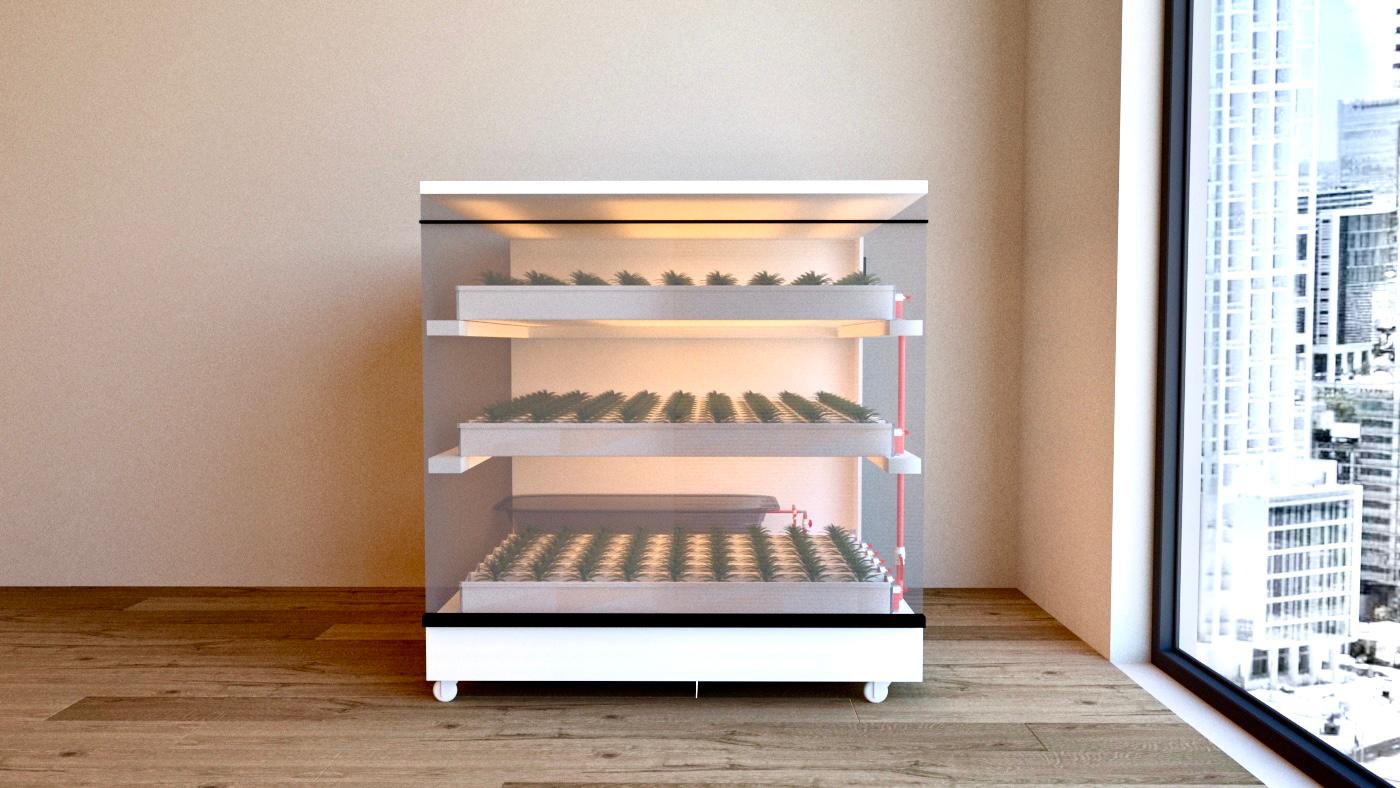
Our main hydroponic project so far is HydroVera, a compact cubic device introduced in Gaza City in 2022 so that families in small apartments could grow food indoors. It was designed to be simple enough for families with no farming experience.
The main lesson: even a small indoor system can change how a family sees its space and its food. Children became some of its most enthusiastic users. Larger units for schools and farms are a direction we hope to develop next.
Conclusion
Hydroponics will not replace soil farming, but it opens food growing to places and people who could not farm before. From a balcony to a classroom, a small system is a practical first step.
See also our model farm for women entrepreneurs and the Palestine Land Lab for our water-efficient soil-based work.