
A playground is often the first public space a child uses on their own terms. Yet many playgrounds are designed for one kind of child: one who can climb, run, balance and cope with noise and crowds. Inclusive playground design starts from a different question: how can children with different physical, sensory, cognitive and social needs play together? This guide explains what an inclusive playground is, why it matters, and the principles that make one work.
What is an inclusive playground?
An inclusive playground goes further than an accessible one. Accessibility means a child who uses a wheelchair can reach the playground. Inclusion means that child can join the same games as everyone else, alongside friends, siblings and parents.
Inclusive play spaces draw on the principles of universal design: places that work for as many people as possible, without separate or “special” versions. A ramp that a wheelchair user, a parent with a pushchair and a toddler can all use is a good example.
Why inclusive play matters
- Development: play builds movement, balance, language and social skills, and every child needs it.
- Belonging: when children play together, difference becomes normal and stigma fades.
- Families: parents and carers with disabilities can supervise and join in.
- Community: a space that works for children with disabilities usually works better for everyone, including older people.
Seven principles of inclusive playground design
1. Make every route accessible
Paths should be firm, level and slip-resistant, and wide enough for a wheelchair and a companion side by side. Use gentle ramps instead of steps wherever possible, and connect every play area, not just the entrance. Loose surfaces such as sand or gravel are hard to cross, so keep them to specific play zones with a firm edge to approach from.
2. Bring play down to ground level
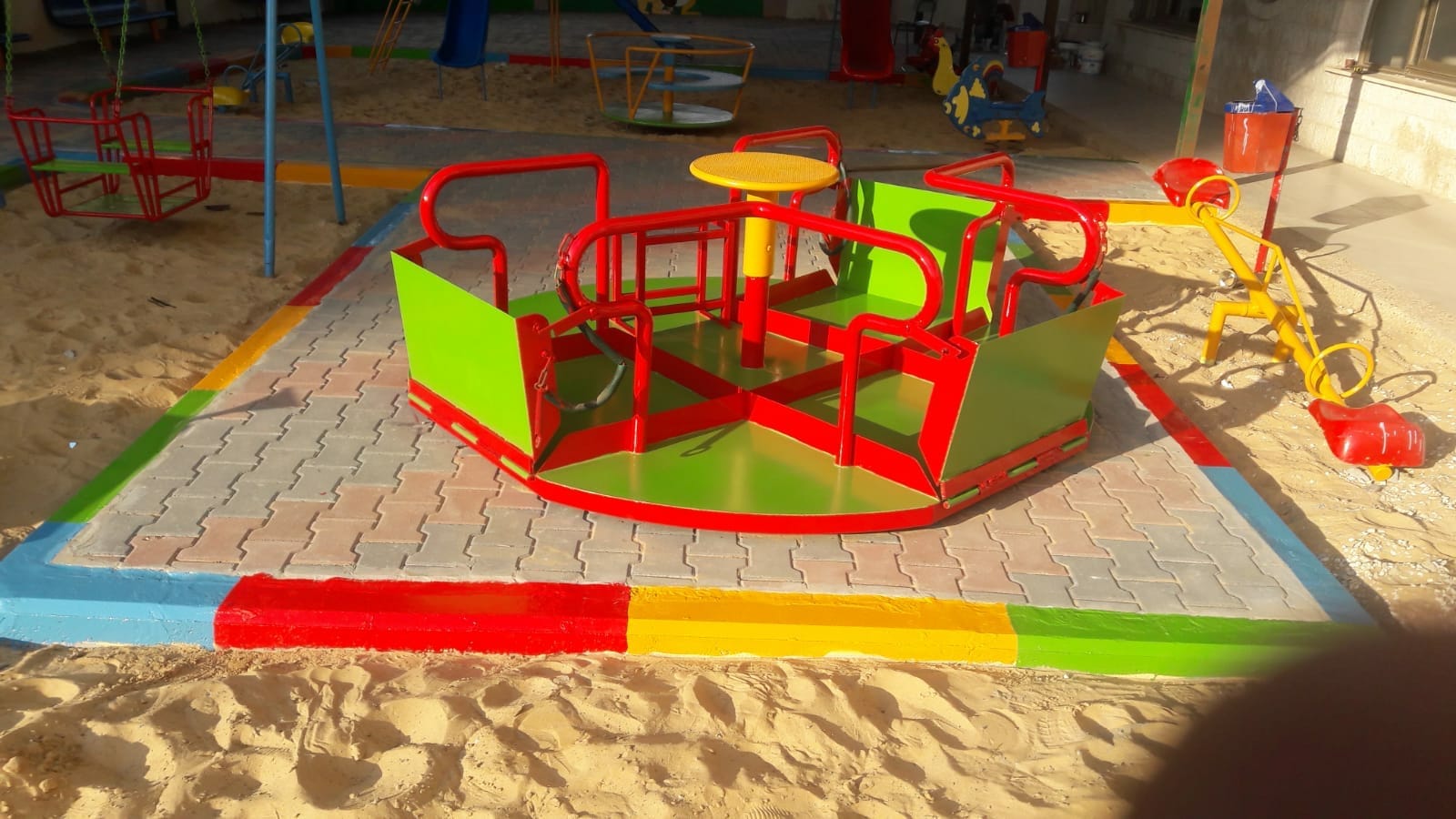
Many children cannot climb, so the most interesting play should not all be at the top of a structure. Ground-level panels, sand and water tables at wheelchair height, wide spinners with flat bases and painted ground games let more children take part.
3. Design for all the senses

Good sensory play mixes sound (chimes, drums, talking tubes), touch (rough, smooth and soft textures), sight (colour and pattern), smell (aromatic plants such as mint, rosemary and lavender) and movement (swinging, rocking, spinning). This variety helps children with visual or hearing impairments, and many autistic children. Add a quiet, enclosed corner where a child who feels overwhelmed can rest without leaving the playground.
4. Use colour and contrast to guide
High-contrast edges, colour-coded zones and clear sightlines help children with low vision find their way. Painted ground games, such as hopscotch, number grids and letter paths, add play and early learning at very low cost.

5. Offer choice and the right level of challenge
Inclusive does not mean easy. Children of every ability need challenge and a little risk. Offer several ways to reach the same place, such as a ramp, a climbing wall and steps, and equipment at different heights, so each child can choose a level that stretches them.
6. Plan for comfort: shade, seating and water
In hot climates, shade decides whether a playground is used at all. Provide trees, pergolas or fabric shade over play areas and seating. Benches with backrests and armrests help carers and older relatives, and a clear space beside each bench lets a wheelchair user sit with their family. Drinking water and nearby accessible toilets make longer visits possible.

7. Design with the community
The people who use a space know its barriers best. Involve children, parents, teachers, therapists and local disability organisations from the first sketch, and test layouts with them on site. Co-design also builds a sense of ownership, so the space is cared for after it opens.
Inclusive play on a small budget
Inclusion depends more on layout and choices than on expensive equipment. Low-cost ideas include:
- Painted ground games on existing paths and walls.
- Reused tyres as seats, tunnels and planters; see our guide to designing with recycled materials.
- A small sensory garden of herbs and textured plants.
- Levelling paths and adding ramps before buying new equipment.
- Shade from timber pergolas and fabric canopies.
Safety in inclusive playgrounds
- Surfaces: under equipment, choose impact-absorbing surfaces that a wheelchair can also cross, such as rubber tiles or poured rubber. Sand and bark absorb falls but are hard to roll over.
- Supervision: keep clear sightlines across the space, with seating where carers can see every area.
- Boundaries: fence the playground near roads, with gates that are easy for adults and hard for small children to open.
- Details: avoid gaps that can trap fingers or heads, and sharp or rough edges, especially on reused materials.
- Maintenance: check equipment and surfaces regularly; a broken ramp makes the whole space inaccessible.
Inclusive schoolyards and outdoor classrooms
The same principles work in schoolyards. A level, shaded yard with a small garden can double as an outdoor classroom, where children learn about plants, numbers and nature while playing. For schools with limited space, this makes every square metre work harder.
Quick checklist
- Can a wheelchair user reach every play area?
- Is there interesting play at ground level?
- Does the space engage sound, touch, sight, smell and movement?
- Is there a quiet corner?
- Is there shade over play and seating?
- Were children and families involved in the design?
Conclusion
An inclusive playground is not a special playground. It is simply a better one: easier to reach, richer to explore and more welcoming to every child and family. If you are planning a playground, schoolyard or community space, our Design Studio can help you design it around the people who will use it.